

Every freelancer has had the experience of delivering work they felt good about, only to receive a client message pointing out an error that was sitting in the document the entire time — the typo in the headline, the wrong company name in the third paragraph, the specification from the brief that never made it into the final piece. The frustrating part is not the error itself. It is the knowledge that a proper review process would have caught it before the client ever saw it, and that you did not have one.
Consistent quality across every deliverable is the single professional characteristic that most reliably produces the client retention referrals and rate premiums that distinguish thriving freelancing businesses from struggling ones. According to the Project Management Institute’s research on professional service quality, consistent and predictable output quality is rated by clients as more important than peak performance in isolated instances — with clients showing significantly higher retention and referral behavior toward service providers whose work is reliably good than toward providers whose work is occasionally exceptional but inconsistently delivered.
Knowing how to build a quality control process for freelancers with AI is the professional infrastructure upgrade that closes the gap between how good your work is when you are at your best and how good your work consistently is across every deliverable you produce regardless of your energy level, your current deadline pressure, or how many projects you are managing simultaneously.
Why Freelancers Skip Quality Control and Why That Has to Change?
The honest reason most freelancers do not have a documented quality control process is not laziness or indifference to quality — it is the combination of time pressure and the confidence trap. The time pressure is real — when a deadline is close, the review process is the step that gets compressed or skipped because the work itself consumed the available time. The confidence trap is subtler — when you have just finished a piece of work that you know intimately, you are the worst possible reviewer of it because your brain reads what it intended to write rather than what is actually on the page.
AI addresses both of these problems simultaneously. A well-structured AI review takes ten to fifteen minutes rather than the hour that a thorough manual review might consume — short enough to fit within even compressed deadline situations. And the AI is reading the deliverable for the first time with no knowledge of what you intended to write — catching the gap between intention and execution that your brain automatically bridges when you review your own work.
The quality control process in this guide is itself an SOP — a documented repeatable procedure that produces consistent outcomes from the same inputs regardless of when in the month you are executing it or how tired you are when you do. For the complete system of building documented procedures across every aspect of your freelancing business check out our guide on how to use AI to create a freelance business SOP library — the complete documentation system that your quality control process fits inside as one of its most valuable components.
The Four Layers of how to build a quality control process for Freelancers with AI
Before building the AI-assisted review process it helps to understand what quality actually means for a freelance deliverable — because a quality control process that checks only one dimension of quality while missing others produces the false confidence of a passed review that still generates client feedback.
Layer 1 — Technical accuracy: Is every fact, figure, name, and specification in the deliverable correct? Does it match the client’s provided information, the brief requirements, and any external sources used?
Layer 2 — Brief alignment: Does the deliverable address everything the client asked for? Are all scope elements present? Does the tone, format, length, and focus match what was agreed in the brief?
Layer 3 — Quality of craft: Is the writing clear, the design coherent, the code functional, or the content organized? Does this deliverable represent genuinely good work in its category beyond simply completing the requirements?
Layer 4 — Client fit: Does this feel right for this specific client — their brand voice, their audience, their stated and unstated preferences based on the relationship you have developed? Would this client recognize their own voice and priorities in this work?
A complete quality control process addresses all four layers. Many freelancers focus only on Layer 3 — the craft quality — while assuming Layers 1, 2, and 4 are handled without explicit review. The errors that most commonly reach clients and generate revision feedback are in Layers 1 and 2 — the technical inaccuracy and the brief element that was missed — rather than the craft quality layer that most freelancers spend the most review attention on.
How to build a quality control process for freelancers with AI
Following steps should be taken on how to build a quality control process for freelancers with AI:
Step 1: Create a Deliverable-Specific Quality Checklist
The foundation of a repeatable quality control process is a checklist specific to each deliverable type you produce — not a generic quality checklist that applies vaguely to everything, but a specific checklist for content writing, a different one for graphic design deliverables, a different one for development handoffs, and so on.
The AI prompt that builds this checklist efficiently:
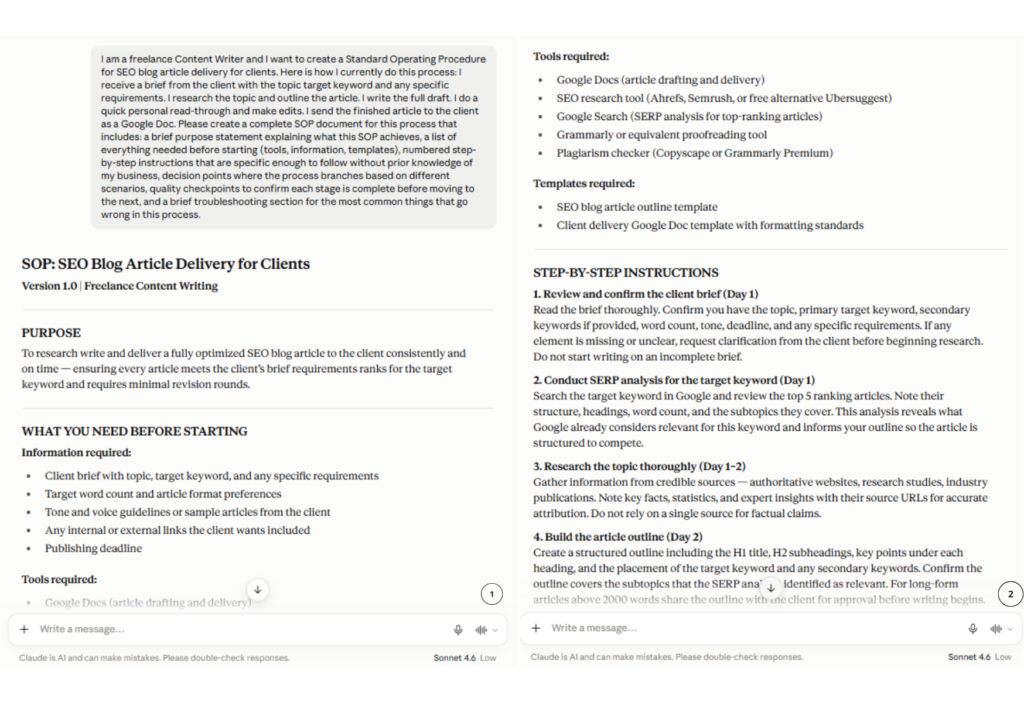
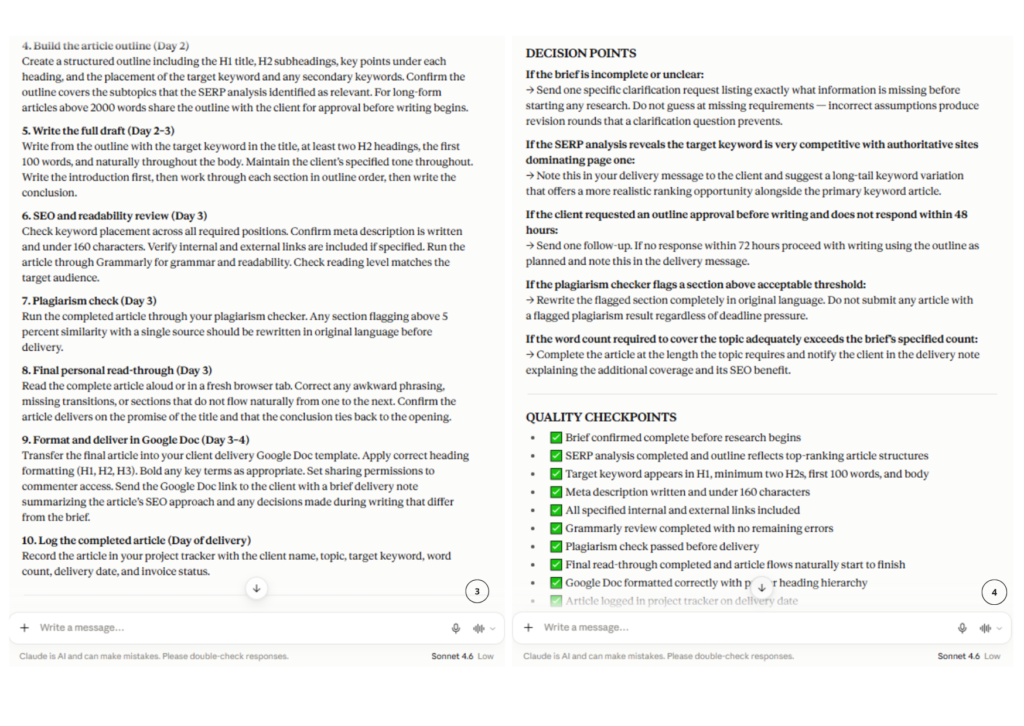
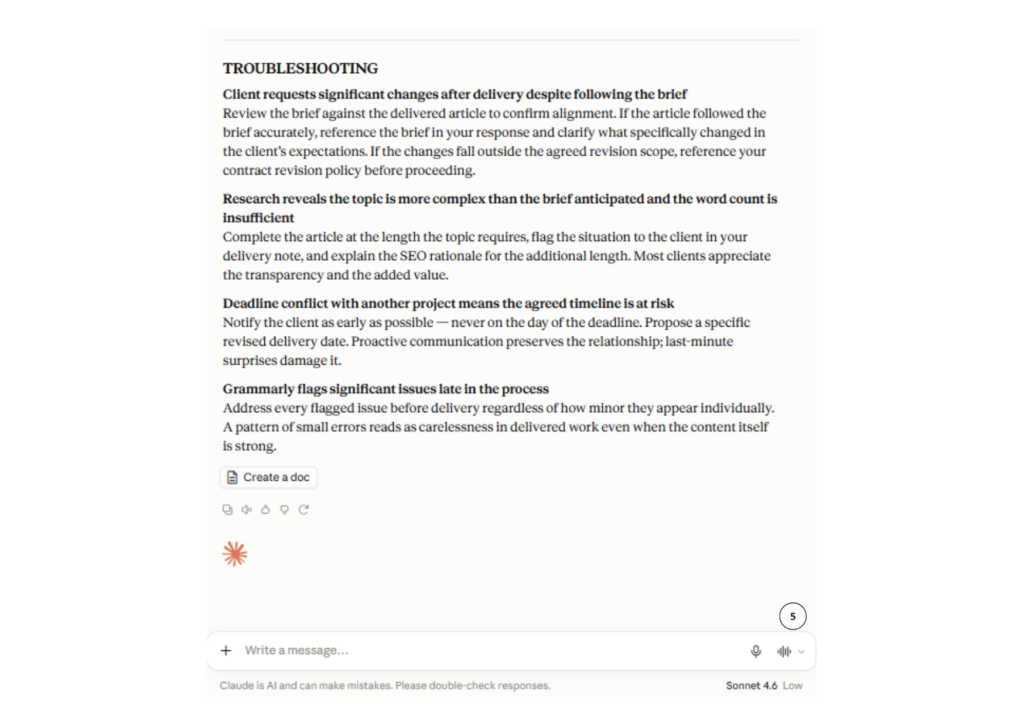
I am a freelance [your service type] who regularly produces [specific deliverable type — e.g., long-form blog articles for B2B clients]. Please create a comprehensive pre-submission quality control checklist for this deliverable type that covers: technical accuracy checks specific to this format, brief alignment verification items, craft quality standards for this deliverable category, and client relationship considerations. Organize the checklist into these four categories and make each item specific and actionable — binary yes or no rather than subjective assessments. The goal is a checklist I can run through in 10 to 15 minutes that catches the errors most likely to generate client revision requests.
The output from this prompt is your starting template — review it and add the items specific to your own clients and your own common error patterns that the AI would not know about from your description alone. The first version is 80 percent there; your additions from your own experience complete it.
Please note that the screenshots below show sample output of the above prompt generated from fictional sample data created specifically to demonstrate how this prompt works in practice. The client, project brief, and deliverable details shown are examples only. When you use this prompt with your own real client brief and actual deliverable your output will reflect your specific project details and will be equally structured and actionable.
Step 2: The AI Brief Alignment Check
The brief alignment check is the most consistently high-value step in the quality control process — the review that compares the completed deliverable against the original client brief to confirm that everything asked for is present and nothing has drifted from the agreed direction.
Paste both the client brief and the completed deliverable into an AI conversation and use this prompt:
Here is the client brief for this project: [paste brief]. Here is my completed deliverable: [paste deliverable]. Please compare the two and: identify every specific requirement in the brief and confirm whether it is addressed in the deliverable, flag any requirements that appear missing or only partially addressed, identify any elements of the deliverable that are not covered by the brief (scope additions that may need client approval), note any inconsistencies between what the brief specified and what the deliverable delivers, and provide a brief summary of the alignment assessment.
This comparison catches the brief element that you addressed early and then inadvertently modified away from the specification in later drafts. It catches the scope addition you made because it improved the work without confirming whether the client wanted it. It catches the format specification that the final deliverable does not match. These are the quality failures that manual self-review consistently misses because they are about the relationship between two documents rather than the quality of either one in isolation.
Note: Run this prompt the same way shown in the screenshots shown in step 1. Paste your client brief and deliverable alongside it and the output will follow the same structured format demonstrated there.
Step 3: The AI Accuracy and Consistency Review
After brief alignment, the accuracy review addresses the technical correctness and internal consistency of the deliverable itself — the facts, names, figures, and terminology that must be correct and must be used consistently throughout.
Please review the following deliverable for: any factual claims that appear inaccurate or that I should verify before submitting, any inconsistencies in names terminology or data points within the document (e.g., a company name spelled two different ways, a statistic cited differently in two places), any statements that are ambiguous enough that a reader might misunderstand the intended meaning, and any formatting inconsistencies (heading styles, list formatting, spacing patterns). List each issue with its location in the document and the specific correction needed.
The AI accuracy review is particularly valuable for identifying internal inconsistencies that human reviewers miss because the human reader’s brain automatically resolves inconsistencies toward a consistent reading — the same way we read what we intended rather than what we wrote. AI reads what is actually there, inconsistencies and all.
Note: Run this prompt the same way shown in the screenshots shown in step 1. Paste your client brief and deliverable alongside it and the output will follow the same structured format demonstrated there.
Step 4: The Tone and Voice Alignment Check
For deliverables where voice and tone are critical — content writing, copywriting, communication scripts, and any deliverable that must sound like a specific person or brand — a dedicated tone check ensures the deliverable sounds right before the client receives it and finds it does not.
Here is the tone and voice specification for this client: [paste brand voice guidelines or describe the client’s tone — formal, conversational, authoritative, warm, etc.]. Here is the deliverable: [paste]. Please assess: how consistently the deliverable maintains the specified tone throughout, specific passages where the tone drifts from the specification, words or phrases that are inconsistent with the specified voice, and the overall tone impression that a first-time reader would receive from this piece.
This check is the one that catches the passage that got slightly too formal when the client specified conversational, the humor that slipped in when the client is a serious professional services firm, and the casual language that appeared in what should have been an authoritative expert piece.
Note: Run this prompt the same way shown in the screenshots shown in step 1. Paste your client’s tone and deliverable alongside it and the output will follow the same structured format demonstrated there.
Step 5: The Client-Specific Final Check
The final quality check before submission is a brief AI-assisted review that considers the specific client relationship context — the accumulated knowledge of what this particular client values, objects to, and has previously responded well or poorly to.
I am submitting a [deliverable type] to a client with the following context: [describe the client — their business type, their communication preferences, any feedback patterns from previous projects, any sensitivities or specific preferences you have learned]. Here is the deliverable: [paste]. Based on this client context please identify: anything in this deliverable that might specifically conflict with this client’s known preferences or sensitivities, any elements that do not align with what has worked well for this client in previous projects, and any elements that this client would likely want different based on their pattern of feedback.
This check is where the accumulated relationship knowledge that experienced client relationships develop produces the most value — the AI operating on the specific context you provide rather than general quality principles, giving the deliverable the client-specific review that a generic quality checklist cannot.
Note: Run this prompt the same way shown in the screenshots shown in step 1. Paste your client brief and deliverable alongside it and the output will follow the same structured format demonstrated there.
Step 6: The 48-Hour Rule for High-Stakes Deliverables
No AI review replaces the value of time distance from your own work for the highest-stakes deliverables. The brain that read and wrote a document thoroughly genuinely does not see it clearly for the first several hours after completion — the familiarity that prevents fresh-eye perception of the errors and improvements that a reader encountering it for the first time would immediately notice.
For high-value deliverables where the stakes of a client quality miss are significant — major project deliverables, work for new clients whose first impression determines the relationship trajectory, content that will be published publicly — build a 48-hour buffer between completion and final review where possible. Run the AI review at completion to catch the technical and brief alignment issues. Run a final human review 24 to 48 hours later when your perception of the work has freshened enough to see it more objectively.
The timeline pressures of freelancing make this buffer impossible for many deliverables — but for the deliverables where it is achievable the quality difference is meaningful and worth building the buffer into your project timeline at the scoping stage rather than discovering the need for it the day before submission.
Building Your Quality Control Process Into a Habit
A quality control process that exists as a document but does not get used on every deliverable is not a quality control process — it is an aspiration. The behavioral habit of running the complete review before every submission is the element that most determines whether this system produces the consistent quality improvement it is capable of producing.
The practical implementation that produces the most consistent adoption is treating the quality control review as a scheduled task in your project workflow rather than an optional add-on at the end. Block the time for the review as part of the project timeline — the 45 minutes before the submission deadline that is allocated to quality review rather than available for additional content creation that bleeds into the review time.
When a deliverable passes your quality control process and still generates significant client revision feedback the most valuable response is not frustration — it is the analytical question of what the quality control process missed and how to update it to catch this category of issue in future deliverables. For the complete system that processes whatever client feedback does arrive after delivery into clear action items check out our guide on how to use AI to turn client feedback into clear action items — the prompt framework that converts even vague subjective feedback into specific executable revision tasks.
Frequently Asked Questions
Q: How long does the complete AI quality control review take?
A: For a standard deliverable of 1,000 to 2,000 words the complete five-step review takes approximately 15 to 25 minutes — the brief alignment check taking the longest at around 8 to 10 minutes and the remaining steps taking 2 to 5 minutes each. For shorter deliverables the complete review runs under 15 minutes. This is the minimum effective review time — rushing through the steps faster than this produces the checkbox completion without the genuine engagement with the AI output that makes the review valuable.
Q: Should I use AI quality control for every deliverable or only major ones?
A: Ideally every deliverable — the consistency that produces the professional reputation for reliable quality comes from consistent application rather than selective application on the deliverables you already give the most attention to. Practically, start with every deliverable above a specific value threshold or for every new client relationship where first impressions most significantly affect the long-term relationship trajectory. Expand to all deliverables as the habit becomes established and the time investment feels routine rather than effortful.
Q: What if the AI quality review identifies a problem that would require significant rework close to a deadline?
A: This is the scenario that the quality control review exists to make possible — better to discover a significant problem 24 hours before the deadline than to have the client discover it after submission. If the problem is significant enough that it cannot be addressed within the remaining time, proactively communicate with the client about a short timeline adjustment rather than submitting work you know has a significant problem and hoping the client does not notice. Most clients respond better to a brief professional timeline communication than to the discovery of a significant issue post-submission.
Q: Can AI quality control replace professional proofreading for client-facing work?
A: AI quality control as described in this guide significantly improves deliverable quality and catches the majority of the errors that human proofreaders catch for most deliverable types. For deliverables where linguistic precision is critical — legal documents, medical content, content where a single factual error has serious consequences — professional human proofreading remains the appropriate standard and AI review should supplement rather than replace it. For the deliverable types that most freelancers produce daily, AI quality control provides a review standard that significantly exceeds self-review without professional proofreading’s cost and timeline.
Conclusion
The freelancer who consistently delivers excellent work is not necessarily the most talented person in their niche. More often they are the person who has built the systems that make consistent quality achievable regardless of the conditions they are working in on any given day — the documented process that catches what tired eyes and overloaded brains inevitably miss when working without it.
AI makes building this system the work of an afternoon rather than months of accumulated quality discipline. The prompts in this guide produce the specific reviews that catch the specific errors that actually generate client revision feedback — and the habit of running them before every submission is the professional infrastructure investment that compounds into the reputation for reliable quality that the best freelancing practices are built on.
Your clients deserve your best work on every delivery. This system makes that consistently achievable.
Explore the complete collection of AI-powered freelancing resources at NextGen Freelancer — NextGen Freelancer Products Page — including the complete quality control system that makes consistent excellent deliverables achievable on every project regardless of deadline pressure or workload volume.