
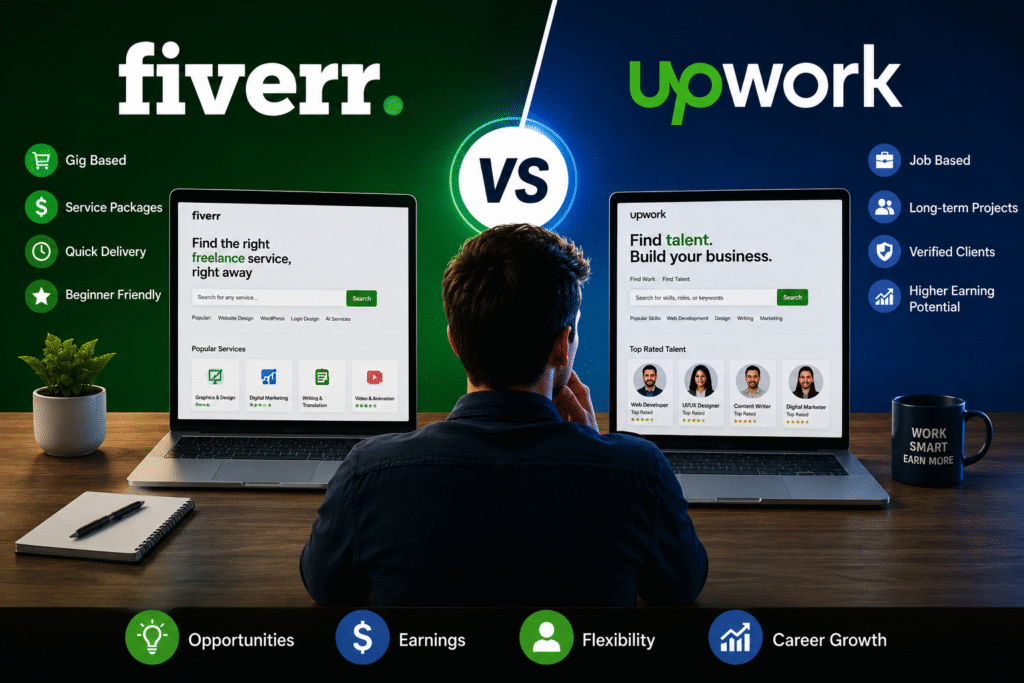
If you have spent any time in freelancing communities you have seen this debate play out hundreds of times. Fiverr fans insist Upwork is overcrowded and impossible to break into. Upwork advocates argue that Fiverr commoditizes your skills and races you to the bottom on price. Both sides have valid points and both sides are missing something important.
The honest answer to the “Fiverr vs Upwork for freelancers in 2026” question is that neither platform is universally better. They are fundamentally different marketplaces that work better for different types of freelancers different service types and different stages of a freelancing career. Choosing the wrong one for your specific situation wastes months of profile building and proposal writing effort that would have produced results on the right platform.
Choosing the right platform is one of the most important early decisions any new freelancer makes. For a complete step by step guide to launching your freelancing career on whichever platform you choose check out our complete guide on how to start freelancing with AI in 2026 — covering everything from niche selection and portfolio building to landing your first client.
This comparison gives you the specific information you need to make the right choice for your service type experience level and income goals in 2026.
Understanding What Each Platform Actually Is?
Before comparing specific features it helps to understand the fundamental difference in how each marketplace operates — because this structural difference explains every other comparison point that follows.
Fiverr is a product marketplace. Sellers create fixed-price service listings called gigs that buyers browse and purchase — similar to an online store where the seller defines the product and the buyer selects and purchases it. The buyer comes to Fiverr knowing what service they want and selects from competing sellers offering that service at different price points.
Upwork is a talent marketplace. Clients post project requirements and freelancers submit proposals competing for selection. The client defines what they need and evaluates competing freelancers before selecting one — similar to a job application process where the employer advertises a role and candidates apply for consideration.
This structural difference produces different client types different competitive dynamics and different income patterns that make each platform better suited to specific types of freelancers and services.
Fiverr vs Upwork — Different Comparisons
Let’s discuss comparisons of both platforms in different categories:
1. Fee Structure
Understanding what each platform takes from your earnings is fundamental to evaluating which produces better net income for your specific situation.
Fiverr
Fiverr takes 20% of every transaction regardless of order size or relationship history with a buyer. A $100 gig earns you $80. A $1,000 gig earns you $800. The 20% fee does not reduce as your relationship with a client deepens or as your total earnings on the platform grow — every transaction incurs the same flat 20% deduction.
Buyers also pay a service fee on top of the gig price — typically 5.5% of the purchase amount with a minimum of $2.50 for orders under $40. This buyer-side fee is separate from your 20% seller deduction and affects how competitive your pricing appears to buyers comparing your total checkout cost against alternatives.
Upwork
Upwork’s Freelancer Service Fee currently ranges from 0% to 15% per contract. The exact fee can vary by contract, and Upwork shows the applicable percentage before you submit a proposal or accept an offer. Once a proposal, offer, or contract is sent, the fee is fixed for the duration of that contract.
Unlike Upwork’s previous sliding-scale fee structure, the current system does not automatically reduce your service fee simply because your lifetime billings with a particular client increase. This means freelancers should check the fee shown for each opportunity when comparing the potential earnings from Upwork with other platforms.
Upwork uses Connects — virtual tokens freelancers spend to submit proposals to job postings. The number of Connects required varies by job, and freelancers can purchase additional Connects when needed. This can create an upfront cost for submitting proposals that Fiverr’s primarily inbound buyer model does not involve.
2. Client Profile Quality
Client quality varies significantly between platforms — not because one platform attracts better people but because the marketplace structure each uses attracts different types of buyers with different budgets expectations and working styles.
Fiverr
Fiverr’s buyer-initiated purchasing model attracts clients who have already decided what they need and are looking for the most affordable provider of that specific service. This attracts a higher proportion of price-sensitive buyers who are comparing multiple sellers primarily on price — the marketplace dynamic that produces the race-to-the-bottom pricing competition that Fiverr critics correctly identify as a real challenge for freelancers trying to command premium rates.
However Fiverr also attracts a significant proportion of buyers who genuinely value quality and are willing to pay for it through the platform’s Pro tier and Level Two and above seller tiers. These quality-focused buyers represent a smaller proportion of total Fiverr buyers but they exist in meaningful numbers and tend to place larger and more satisfying orders than budget-focused buyers.
The average Fiverr client tends to want a specific deliverable completed efficiently without extensive consultation or collaborative process — a buyer who knows what they want and wants it delivered without significant back and forth.
Upwork
Upwork’s project-posting model attracts clients who are willing to invest time in finding and evaluating the right freelancer for a project — a selection process that typically indicates higher project value and more serious client investment in the outcome. Clients who post detailed Upwork job descriptions and evaluate multiple proposals are generally more committed to quality and more willing to pay appropriately for it than buyers who make impulse purchases on Fiverr.
The average Upwork client tends to be a business or marketing professional managing a significant project who wants a collaborative working relationship rather than a simple deliverable purchase — a buyer who values communication expertise and professional judgment alongside the specific deliverable.
This client profile difference typically produces higher per-project billing on Upwork for equivalent service quality — but requires more front-end investment in proposal writing and client evaluation processes before earning begins.
3. Earning Potential
The earning potential comparison between Fiverr and Upwork is more nuanced than platform fee comparisons alone suggest.
Fiverr
Fiverr’s earning potential is most significant for freelancers who can productize their services into clearly defined repeatable deliverables that buyers can understand and purchase without consultation. Graphic designers who create specific logo styles copywriters who produce specific content formats and voiceover artists who deliver specific recording types are examples of freelancers whose services translate naturally into Fiverr’s product purchase model.
Top Fiverr sellers in competitive categories earn very significant monthly incomes — but reaching top seller status requires substantial review accumulation and profile optimization that takes months of consistent delivery at initially modest prices before the platform’s algorithm surfaces your gigs prominently enough to generate the volume that top earners produce.
Upwork
Upwork’s earning potential is most significant for freelancers who offer consultative complex or ongoing services that require client collaboration and cannot be easily productized into a standard purchase. Software developers who build custom applications marketing strategists who develop bespoke campaigns and business consultants who provide ongoing advisory services are examples of freelancers whose work translates naturally into Upwork’s project evaluation model.
Upwork’s long-term client relationship fee structure means that freelancers who successfully establish ongoing client relationships effectively reduce their platform fee over time — increasing net earnings from the same gross billing without requiring rate increases. This compounding relationship value makes Upwork significantly more financially rewarding for freelancers who prioritize relationship depth over transaction volume.

4. Profile and Getting Started
The initial profile setup and early traction experience differs significantly between the two platforms in ways that affect which is more appropriate for freelancers at different experience levels.
Fiverr
Fiverr’s gig creation process is relatively straightforward — you create a service listing with a title description pricing tiers and package details without requiring an application or approval process beyond basic account verification. Your gig goes live immediately and is theoretically visible to buyers from day one.
The practical challenge is that new Fiverr gigs with no reviews are buried in search results behind established sellers with hundreds or thousands of positive reviews. Getting your first review requires either offering initially reduced pricing to attract first buyers or finding buyers through external promotion rather than organic Fiverr search discovery.
Upwork
Upwork requires a profile approval process that can take several days and that is not guaranteed — Upwork periodically restricts new account approvals in oversupplied categories. Once approved new freelancers must purchase Connects to submit proposals to job postings — creating an upfront cost before earning begins.
The proposal competition dynamic means that new freelancers without Upwork reviews compete against established profiles with extensive review histories — a disadvantage that is real but that a well-written targeted proposal can overcome more effectively than search ranking algorithm disadvantages on Fiverr.
5. Which Types of Freelancers Thrive on Each Platform?
Here is the comparison of two platforms regarding the fact that how freelancers thrive to work on each platform.
Fiverr Works Best For
Freelancers offering clearly productizable services with specific deliverables that buyers can understand without consultation. Creative services like logo design illustration voiceover video editing and specific writing formats perform particularly well. Freelancers who want inbound client flow without proposal writing — Fiverr’s model means buyers come to you rather than you pursuing them. Early-career freelancers who want to build a review portfolio quickly through accessible lower-priced initial gigs. Freelancers whose services suit the one-off purchase model rather than requiring ongoing client relationships.
Upwork Works Best For
Freelancers offering complex consultative or technical services that require client briefing and collaboration rather than standard deliverable production. Software development business consulting marketing strategy project management and complex writing services perform particularly well. Freelancers who want to build long-term client relationships that reduce platform fees and provide income stability. Experienced freelancers with a portfolio that demonstrates expertise convincingly enough to win proposals against established competition. Freelancers whose services naturally suit ongoing retainer relationships that Upwork’s fee structure particularly rewards.
Should You Use Both Platforms?
Many experienced freelancers maintain profiles on both platforms — using Fiverr for the standardized repeatable service components of their offering and Upwork for the custom complex higher-value project work. This dual-platform approach diversifies client acquisition channels and reduces dependency on either platform’s algorithm changes or policy updates.
The practical challenge of maintaining active profiles on both platforms is the time investment required for platform-specific optimization — Fiverr gig management and Upwork proposal writing are both time-consuming activities that combined can consume significant hours that might be better invested in direct client development or personal brand building.
For most new freelancers choosing the single platform that best matches their service type and building a strong presence there before diversifying to a second platform produces better results than splitting effort between both from the start.
Fiverr vs Upwork in 2026 — What Has Changed?
Both platforms have evolved significantly in recent years in ways that affect which is more attractive for freelancers in 2026 specifically.
Fiverr has expanded its Pro marketplace — a vetted tier for experienced professionals that commands significantly higher prices than standard gigs and attracts the quality-focused buyers who were previously underserved by Fiverr’s price-competitive standard marketplace. For experienced freelancers who can meet Fiverr Pro requirements this tier significantly changes the Fiverr earning potential calculation.
Upwork has introduced AI-powered proposal assistance and matching features that help newer freelancers write more competitive proposals — partially addressing the experience disadvantage that new Upwork freelancers face against established profiles. The platform has also expanded its Project Catalog feature — fixed-price service listings similar to Fiverr gigs — giving freelancers the option of both inbound product-style sales and outbound proposal-based client acquisition on a single platform.
The Verdict — Fiverr vs Upwork for Freelancers in 2026
Platform success on both Fiverr and Upwork comes down to the same fundamentals regardless of which one you choose. Make sure you are not making the avoidable errors that hold most new freelancers back — check out our guide to the 15 mistakes new freelancers make and how AI helps you avoid every single one.
Choose Fiverr if your service is clearly productizable you prefer inbound client flow over proposal writing and you are building toward a high-volume repeatable service business.
Choose Upwork if your service is consultative complex or ongoing you prefer working with serious professional clients who value expertise and you want to build long-term client relationships that reward loyalty through reduced fees.
Use both if you offer both standardized and custom service variants you have the time to maintain active presence on two platforms and you want to diversify your client acquisition channels beyond any single platform’s algorithm.
Want proposal templates and profile optimization scripts for both Fiverr and Upwork that are already written and ready to customize? Check out the NextGen Freelancer Platform Success Pack.
Frequently Asked Questions
Q: Which platform has less competition — Fiverr or Upwork?
A: Both platforms are competitive but in different ways. Fiverr competition is primarily price-based — many sellers offering similar services at different price points with buyers selecting primarily on price and reviews. Upwork competition is proposal-based — freelancers competing through the quality of their proposal and profile rather than primarily through price. Freelancers who write compelling proposals tend to find Upwork competition more manageable than the algorithmic search ranking competition on Fiverr.
Q: Can you make a full-time income on Fiverr or Upwork alone?
A: Yes — many freelancers generate full-time income on each platform independently. The timeline to full-time income varies significantly based on service type pricing strategy and the consistency of profile optimization and client communication. Most successful platform freelancers recommend building toward full-time platform income as a transitional step while simultaneously developing direct client relationships and personal brand visibility that create income independence from platform algorithms and policies.
Q: Is it worth paying for Upwork Plus or Fiverr Seller Plus memberships?
A: Both platform premium memberships offer specific advantages — Upwork Plus provides additional Connects and profile visibility features while Fiverr Seller Plus offers analytics and promotional tools. The value depends on your specific usage level. Freelancers actively submitting multiple Upwork proposals weekly will typically find Plus’s Connects allocation valuable. Fiverr Seller Plus analytics become more valuable once your gig has enough traffic data to act on meaningfully.
Q: Which platform is better for raising your rates over time?
A: Upwork’s long-term client relationship model makes rate increases with existing clients more achievable — clients who have worked with you through multiple successful projects are more receptive to rate increases than new buyers encountering your Fiverr gig for the first time. Fiverr rate increases typically require gig restructuring and are more effectively implemented through package tier upgrades than direct rate increases on existing gig structures.
Q: Are there better alternatives to both Fiverr and Upwork in 2026?
A: Several platforms serve specific niches more effectively than either Fiverr or Upwork — Toptal for elite technical talent 99designs for design competitions Contently for established content writers and LinkedIn Services Marketplace for consultative professional services. The best platform for any individual freelancer depends on their specific service type experience level and target client profile rather than universal platform superiority.
Conclusion
The Fiverr vs Upwork debate does not have a universal winner because they are different tools that serve different purposes. A hammer is not better than a screwdriver — it depends entirely on what you are trying to build.
Evaluate your service type your preferred working style and your income goals against the platform characteristics in this comparison. Choose the platform that genuinely fits your situation rather than the one with the loudest advocates in the communities you follow. Build a strong optimized presence on that platform before diversifying.
The platform you choose matters significantly less than what you do on it — a mediocre presence on the right platform produces worse results than an excellent presence on the wrong one.
Explore the complete collection of AI-powered freelancing resources at NextGen Freelancer — NextGen Freelancer Products page — including platform-specific templates and optimization guides for both Fiverr and Upwork.