

Here is a question that most freelancers cannot answer with any precision: which of your clients generates the most profit per hour of your actual time — not revenue, but profit accounting for the time spent on communication revisions administration and unpaid scope alongside the billable hours? If you cannot answer that question without a significant manual data exercise, you are making client relationship and business development decisions without the information that would most directly improve your income. That information exists in your existing business data. You just have not had a practical way to extract it efficiently. Until now.
Using AI to analyze your freelance business is one of the highest-leverage applications of AI tools available to independent professionals in 2026. According to McKinsey Global Institute’s research on AI adoption among knowledge workers, professionals who use AI tools for business analysis and strategic planning report identifying improvement opportunities they would otherwise have missed in routine work reviews — with AI-assisted analysis surfacing patterns in business data that manual review consistently overlooks due to cognitive bias and limited analytical bandwidth.
This guide walks through exactly how to use AI to analyze your freelance business across every dimension that matters — income patterns, client profitability, time allocation, pricing adequacy, and strategic positioning — and how to turn what that analysis reveals into a specific improvement plan that you can start executing this week.
Why Most Freelancers Never Properly Analyze Their Own Business
There is a specific irony in the freelancing experience that almost every independent professional recognizes when it is pointed out to them. They are running a business — making decisions about clients, services, pricing, and time allocation every single day — without the analytical clarity that even the most basic business review would provide. The reason is not laziness or lack of intelligence. It is that proper business analysis traditionally required either significant time investment in manual data review or the expense of a business coach or consultant who could provide the outside perspective that owners cannot give themselves.
AI changes this equation fundamentally. The conversational AI tools available in 2026 can process the business data you already have, identify patterns you would take hours to spot manually, surface the uncomfortable truths that cognitive bias in self-assessment consistently conceals, and generate specific actionable recommendations — all in an afternoon using information you already possess but have never organized for systematic analysis.
The freelancer who does this analysis once per quarter has a business intelligence advantage over competitors who operate on instinct and habit that compounds significantly over time — the accumulating clarity about what actually drives their income that directs effort toward the highest-return activities rather than the most comfortable or most familiar ones.
What You Need to Prepare Before the Analysis Session
The quality of AI business analysis depends entirely on the quality of the data you bring to the session. Spending thirty to sixty minutes gathering and organizing your business data before beginning the AI conversation produces dramatically more useful analysis than attempting the same conversation from memory alone.
Income data — Pull your invoices or payment records for the past six to twelve months and create a simple summary: client name, project type, total invoiced, date paid, and approximate hours spent. This does not need to be a sophisticated accounting document — a simple spreadsheet or even a list in a text document gives the AI the raw material it needs for meaningful pattern analysis.
Time tracking data — If you track time formally, export your time records for the same period. If you do not track time formally — and most freelancers do not — make honest estimates per client and project from memory and calendar review. Imprecise time data is still more useful than no time data for the profitability calculations that reveal the most important client relationship insights.
Client communication volume — A rough count of the emails, messages, and calls each client required per project or per month. This communication overhead is a real time cost that invoiced amounts do not capture and that profitability calculations must include to be accurate.
Your service list and pricing — The specific services you currently offer and the rates you charge for each, alongside the rates you were charging twelve months ago if they have changed.
Your goals — What you are actually trying to achieve with your freelancing business. More income, fewer clients, more specific types of work, better work-life balance, a specific income target. The AI analysis is most useful when it is oriented toward specific goals rather than abstract improvement.
Key Areas on How to Use AI to Analyze Your Freelance Business
In the following, we have discussed different key areas on How to use AI to Analyze Your Freelance Business:
Analysis Area 1: Income Pattern Review
The first and most illuminating AI analysis for most freelancers is a comprehensive income pattern review — feeding your twelve-month income summary into an AI conversation and asking it to identify patterns that your own review of the same data consistently misses.
How to prompt it:
Paste your income data into Claude or ChatGPT and use a prompt along these lines:
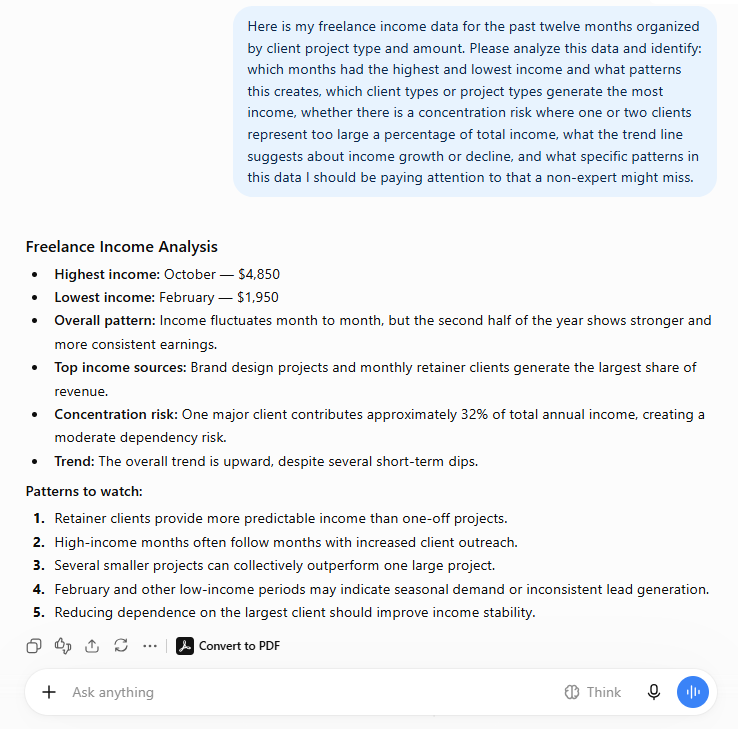
Here is my freelance income data for the past twelve months organized by client project type and amount. Please analyze this data and identify: which months had the highest and lowest income and what patterns this creates, which client types or project types generate the most income, whether there is a concentration risk where one or two clients represent too large a percentage of total income, what the trend line suggests about income growth or decline, and what specific patterns in this data I should be paying attention to that a non-expert might miss.
What typically emerges from this analysis is more revealing than most freelancers expect. The month-on-month income pattern that reveals a seasonal dip you had not consciously identified. The single client who represents 45 percent of annual income — a concentration risk that feels like a strength until that client relationship ends. The project type that generates the most income consistently but that you have been underinvesting in because other work felt more immediate.
See the following screenshot showing ChatGPT’s output from the prompt above, using sample freelance income data:
Analysis Area 2: Client Profitability Audit
Client analysis is the second most valuable output of an AI-assisted freelance business review — the pattern recognition across your client roster that identifies which relationships are genuinely profitable and which are consuming disproportionate time and energy relative to the income they generate. And when AI analysis reveals a problematic client relationship check out our complete guide on how to deal with difficult freelance clients — the professional strategies that resolve client problems without losing your income or your professional reputation.
The real profitability calculation:
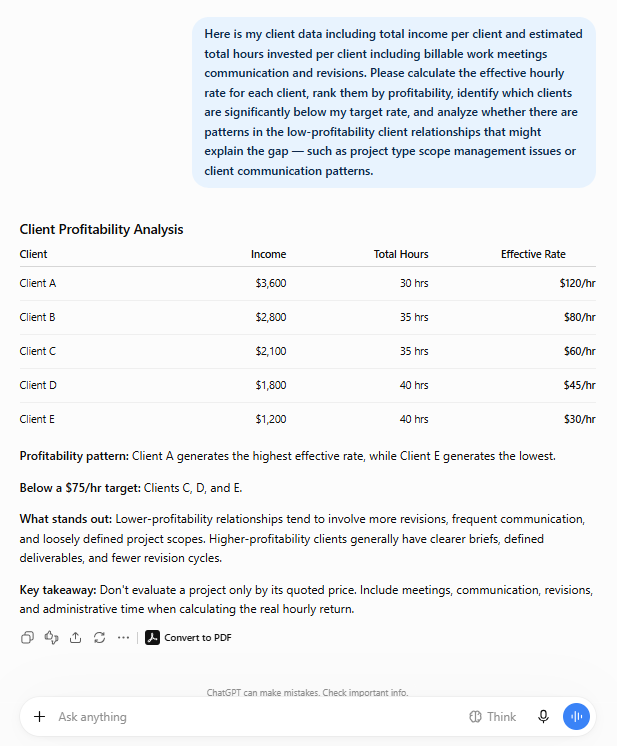
Most freelancers evaluate client profitability by invoice amount — the client who pays the most feels like the best client. But the more accurate profitability metric is effective hourly rate: total income from the client divided by total hours invested including meetings emails revisions and all administrative work. This calculation frequently produces surprises.
Feed your per-client time and income data to the AI with this prompt:
Here is my client data including total income per client and estimated total hours invested per client including billable work meetings communication and revisions. Please calculate the effective hourly rate for each client, rank them by profitability, identify which clients are significantly below my target rate, and analyze whether there are patterns in the low-profitability client relationships that might explain the gap — such as project type scope management issues or client communication patterns.
The client who invoices at the lowest rate but requires minimal communication and zero revision requests often emerges as the most profitable relationship. The client who pays a premium rate but demands constant availability, extensive revisions, and scope expansions often emerges as one of the least profitable despite feeling lucrative based on invoice amounts alone.
See the following screenshot showing ChatGPT’s output from the prompt above, using sample freelance income data:
Analysis Area 3: Time Allocation Review
Where your time actually goes versus where you believe it goes is one of the most consistently illuminating gaps in freelance self-knowledge — and AI analysis of time data makes this gap visible in ways that memory-based self-assessment never reliably produces.
The time allocation prompt:
Based on my estimated time allocation across the past three months — [paste your time summary by category: client work, business development, administration, professional development, etc.] — please analyze whether this allocation is likely optimal for my stated goals of [your specific goals]. Identify which activities are consuming time disproportionate to their contribution to my goals, which high-value activities appear underinvested relative to their importance, and what a more strategically optimal time allocation might look like for a freelancer with my goals and income profile.
The time allocation analysis almost always reveals two things simultaneously. The administrative and low-value tasks that consume more time than the freelancer realizes — the email management, the invoice chasing, the project coordination overhead. And the high-value business development activities like content creation, networking, and skill development that get squeezed into whatever time remains after client work and administration — the activities that would most improve the business if given more structured time rather than the leftover hours that other work does not consume.
Analysis Area 4: Pricing Adequacy Assessment
Pricing is almost always the area where AI analysis surfaces the most immediately actionable improvement opportunity for freelancers who have never systematically reviewed their rates against market data and their own service delivery costs. For the complete pricing system that acts on what your AI analysis reveals check out our guide on how to price your freelance services in 2026 — the proven framework for calculating your minimum viable rate choosing the right pricing model and raising your rates with confidence.
The pricing analysis prompt:
I am a freelancer offering [your specific services] to [your target client type]. My current rates are [your rates]. My annual income target is [your target] and I work approximately [your hours] billable hours per month. Please analyze whether my current rates are consistent with reaching my income target, how my rates compare to market rates for equivalent services based on your knowledge, which of my services appear underpriced relative to the value they deliver, and what a rate increase roadmap might look like for the next twelve months.
The AI’s market rate knowledge — while not perfectly current — provides a useful reference framework for identifying rates that are significantly below market even accounting for knowledge cutoff. More importantly the mathematical analysis of whether your current rates can produce your income target at your available hours is a calculation that takes thirty seconds for AI to run and that many freelancers have genuinely never completed despite the directness with which it answers the income growth question.
Analysis Area 5: Service Mix Optimization
The services you offer and the proportions in which you offer them have a disproportionate effect on both income and satisfaction — and AI analysis of your current service mix against your goals often surfaces opportunities to shift the mix toward higher-value services that are already within your capability but underrepresented in your current client work.
The service mix prompt:
Here is my current service mix — [list services and approximate percentage of income each represents]. Here are my stated business goals — [your goals]. Please analyze whether my current service mix is well-aligned with my goals, which services have the highest income potential relative to time investment, which services I might be underoffering given my apparent expertise, and what a more strategically optimal service mix might look like for a freelancer with my profile and goals.
Building Your Improvement Roadmap From the Analysis
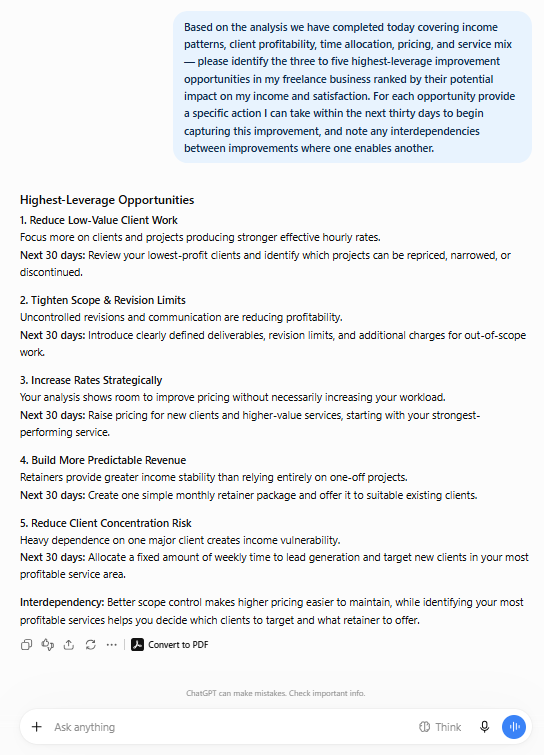
The AI analysis across these five areas produces a significant amount of insight — more than can be acted on simultaneously without the overwhelming diffusion of effort that trying to improve everything at once produces. The final AI conversation in your business analysis session synthesizes all of this into a prioritized improvement plan.
The synthesis prompt:
Based on the analysis we have completed today covering income patterns, client profitability, time allocation, pricing, and service mix — please identify the three to five highest-leverage improvement opportunities in my freelance business ranked by their potential impact on my income and satisfaction. For each opportunity provide a specific action I can take within the next thirty days to begin capturing this improvement, and note any interdependencies between improvements where one enables another.
The ranked output from this prompt is your improvement roadmap — specific, prioritized, and grounded in your actual business data rather than generic freelancing advice that may or may not apply to your specific situation and goals.
See the following screenshot showing ChatGPT’s output from the prompt above, using sample freelance income data:
Making AI Business Analysis a Quarterly Practice
The freelancer who does this analysis once gets one month of improved strategic clarity. The freelancer who does it every quarter develops the compounding business intelligence that continuously redirects effort toward the highest-return activities and continuously surfaces the emerging issues that quarterly data reveals before they become significant problems.
The quarterly cadence suits most freelancing businesses better than monthly — frequent enough to catch meaningful trend changes and provide course correction opportunity while not so frequent that the analysis itself becomes a significant time investment relative to the insights it generates. Block one afternoon per quarter in your calendar, gather your data, run through the five analysis areas in sequence, and build your improvement roadmap for the next ninety days.
Frequently Asked Questions
Q: Do I need accounting software or formal financial records for this analysis to be useful?
A: No — the analysis works with whatever data you have including rough estimates and memory-based summaries. More precise data produces more precise analysis, but the pattern recognition that AI provides from approximate data is still significantly more useful than no analysis at all. If this quarterly practice motivates you to track time and income more formally going forward, that is a valuable side effect — but it is not a prerequisite for getting started today.
Q: Which AI tool is best for freelance business analysis?
A: Both Claude and ChatGPT handle this analytical task well. Claude tends to produce more nuanced and careful analysis on ambiguous data while ChatGPT produces faster and more structured output that is easy to act on immediately. Try both with the same prompt and data and use whichever produces the analysis style that best matches how you think. The prompt quality and data quality matter more than the tool choice for this specific application.
Q: What if the AI analysis reveals uncomfortable truths about my business?
A: This is actually the most valuable outcome the analysis can produce — the uncomfortable truth that you have been avoiding through the cognitive bias that self-assessment consistently applies to protect existing habits and relationships. A client relationship that feels important but is revealed as significantly unprofitable, a service that feels like a core offering but generates minimal income, a time allocation that feels productive but is revealed as heavily weighted toward low-value activities — these uncomfortable discoveries are the ones whose acknowledgment produces the most significant business improvements.
Q: How much time does the complete analysis take?
A: Data gathering takes thirty to sixty minutes depending on how organized your records are. The five AI analysis conversations take approximately two to three hours with the synthesis at the end. The complete quarterly business analysis session runs three to four hours total — a worthwhile investment for the strategic clarity it produces relative to the four-figure business coaching equivalent that provides similar insight from a human professional.
Conclusion
The freelancing business that is genuinely analyzed — whose income patterns, client profitability, time allocation, pricing, and service mix are regularly examined against actual data rather than intuition and habit — consistently outperforms the equivalent-skill business that operates without this analytical clarity. AI has made this analysis accessible to every freelancer regardless of whether they have a business background, accounting software, or a coach who can provide outside perspective.
Your business data already tells a story about what is working, what is not, and where the highest-return improvements are available. AI is the tool that reads that story and translates it into specific actions. The analysis is available to you this afternoon. The improvements it reveals are available to you this week.
Explore the complete collection of AI-powered freelancing resources at NextGen Freelancer — NextGen Freelancer Products Page — including the complete business analysis system that makes every quarterly review immediately actionable.